Chitika

Showing posts with label politics. Show all posts

Friday, June 26

Banning the burqa is not the solution, but it's a start

French President Sarkozy recently reignited the debate over the burqa or the veil that some Muslim women wear. He said that the
...burqa is not a religious sign. It is a sign of subservience, a sign of debasement. It will not be welcome on the territory of the French Republic.
I disagree with the French president...but only with the second part of this quote. But first, let me preface my argument with my own thoughts on the the burqa, also spelled as burka and may be referred to as the hijab or the chador as well. (In this post, I am referring only to the complete head to toe burqa, with perhaps a slit or netting for the eyes. In this outfit, the face is not visible. The headscarf is something very different, and is what some women in my family back home in Pakistan wear.)

I believe that the burqa really is a construct of a misogynistic and feudal society. And there is no doubting the fact that Islamic societies have suppressed the rights of women for as long as one can remember. The cause of this evil (and it really is evil...) is not Islam, however, because Islam was meant to be the cure. In its purest form, Islamic teachings do make valiant efforts to raise the status of women, but these teachings have fallen to deaf ears. The real reason in my opinion, is illiteracy, and the fact that Islam spread like wildfire through lands that were already pagan, uneducated, and heavily misogynistic. Islam was meant to heal these ancient feudal lands of this backbreaking curse on women, but has instead become associated with women's rights violations. But that is the past, yet today things have not changed much. Therefore, in this day and age, Islamic leaders and followers deserve the blame for the imbalance of power between the sexes.

Moreover, I don't see how the burqa helps a woman as I believe it disconnects her from society at large, especially Western society. And it is unfortunate that it is mostly Western leadership that is denouncing the veil. Jack Straw, the former British foreign Minister once wrote that, "wearing the full veil was bound to make better, positive relations between the two communities more difficult". This careful statement is completely true, and besides the obvious community aspects, the head to toe covering must be unbearably uncomfortable. I can not fathom how a woman enjoys wearing something completely covering her up and is barely able to walk. It's also a safety issue. I've seen women driving with their faces covered, and its obvious to see that their peripheral vision is limited. That's just as dangerous as driving with your eyes closed.

However, even after all this, I believe it is the right of any woman to decide whether she wants to wear a burqa or not. We must recognize the fact that not all women wear the veil on their own free will. Let's not be naive here. There is immense pressure on women to wear the veil, especially if her community at large wears it. In fact most women don't even have the choice to NOT wear the veil. In these situations, both the Islamic leadership and the country in question, must provide avenues for discussion, and safety for the woman who decides against the burqa. If women choose not to wear the veil, then they should be allowed to do so, with adequate protection from their community and country. I believe the President Sarkozy should communicate with Muslim leadership in his country and convey such a point. Banning the veil outright, and imposing his belief system on another person is just plain wrong, to quote my brother.

Muslims (mostly men) around the world have been incensed with the French president's stance. They all believe that Muslim women must have the right to choose to wear the burqa. That's no problem. But these same Muslims must realize that they must provide their women with the right to NOT choose to wear the burqa as well. And that's really where the problem stems. President Sarkozy recognizes that Muslims societies are not willing to give up this stranglehold on women and what they wear. Wearing the burqa has become such an integral part of Muslim societies that people don't realize that its not an Islamic practice in the first place. And even if some sects believe that it is a integral practice, then they must allow their women the choose to wear it or not. And it is these women that must be protected. The issue isn't Jack Straw or President Sarkozy being racists against Islam, but the problem is that Islamic societies are unwilling to change and unwilling to remove the sexist policies of their uneducated, pagan past.

Sunday, April 19

Recent op-eds about Pakistan paint a dire picture

Recent op-eds in various newspapers have painted a terribly dire picture of Pakistan's current situation and future prospects. The opinion pieces that one reads every once in a while about Pakistan, aren't usually particularly rosy, but this sudden clumping of articles over the past few weeks is worrisome as the situation gets progressively worse.

The stranglehold of the Taliban in the northwest, the flogging of a peasant girl, and the peace treaty with Taliban forces have dominated headlines, sparked debate, and have caught the elite in Pakistan and the bourgeoisie by surprise. However the news item that bothered me the most, and if true, will be the biggest threat to the country's stability, is the possible Talibanization of Punjab, which is the heart of Pakistan. A recent New York Times article entitled, "United Militants Threaten Pakistan's Populous Heart" reported the following:

Telltale signs of creeping militancy abound in a belt of towns and villages near here that a reporter visited last week. Militants have gained strength considerably in the district of Dera Ghazi Khan, which is a gateway both to Taliban-controlled areas and the heart of Punjab, the police and local residents say. Many were terrified. Some villages, just north of here, are so deeply infiltrated by militants that they are already considered no-go zones by their neighbors.

In at least five towns in southern and western Punjab, including the midsize hub of Multan, barber shops, music stores and Internet cafes offensive to the militants’ strict interpretation of Islam have received threats. Traditional ceremonies that include drumming and dancing have been halted in some areas. Hard-line ideologues have addressed large crowds to push their idea of Islamic revolution. Sectarian attacks, dormant here since the 1990s, have erupted once again.

Sadly, the Taliban are exposing one of the biggest weaknesses in Pakistan, and that is the disconnect between the peasants and the ruling class. They are simply providing these peasants an alternative rule. Pakistani feudal lords and the government have had a stranglehold on the livelihoods of the poor, leaving them frustrated and aching for change. The Taliban are simply filling the void.

...people complain that landowners and local politicians have done nothing to stop the advance and, in some cases, even assist the militants by giving money to some of the religious schools.

“The government is useless,” said Mr. Ali, the local landlord. “They live happy, secure lives in Lahore. Their children study abroad. They only come here to contest elections.”

The police are left alone to stop the advance. But in Punjab, as in much of the rest of Pakistan, they are spread unevenly, with little presence in rural areas. Out of 160,000 police officers in Punjab, fewer than 60,000 are posted in rural areas, leaving frontier stations in districts virtually unprotected, police officials said.

Locals feel helpless. When a 15-year-old boy vanished from a madrasa in a village near here recently — his classmates said to go on jihad — his uncle could not afford to go look for him, let alone confront the powerful men who run the madrasa.

“We are simple people,” the man said. “What can we do?”

I've always felt that what Pakistan needs is a revolution from the ground up. With the poor standing up to the feudal lords, fighting for better pay, for better schools and job opportunities for their children. I just wish it wasn't in concordance with the Taliban. Armchair Pakistani's like myself, aren't the only ones worried. According to the following article, entitled, "Pakistan on course to becoming Islamist State", Western intelligence officials agree that Talibanization is spreading fast.

"The place is beyond redemption," said a Pentagon adviser who asked not to be further identified so he could speak freely. "I don't see any plausible scenario under which the present government or its most likely successor will mobilize the economic, political and security resources to push back this rising tide of violence.

"I think Pakistan is moving toward a situation where the extremists control virtually all of the countryside and the government controls only the urban centers," he continued. "If you look out 10 years, I think the government will be overrun by Islamic militants."

That pessimistic view of Pakistan's future has been bolstered by Islamabad's surrender this week for the first time of areas outside the frontier tribal region to Pakistan's Taliban movement and by a growing militant infiltration of Karachi , the nation's financial center, and the industrial and political heartland province of Punjab, in part to evade U.S. drone strikes in the tribal belt.

The Taliban aren't the only ones that are feeding off the discontent sweeping the masses. A recent Atlantic piece talks about the discontent Baluchi's and summarizes that...

With its “Islamic” nuclear bomb, Taliban- and al-Qaeda-infested borderlands, dysfunctional cities, and feuding ethnic groups, Pakistan may well be the world’s most dangerous country, a nuclear Yugoslavia-in-the-making. One key to its fate is the future of Gwadar, a strategic port whose development will either unlock the riches of Central Asia, or plunge Pakistan into a savage, and potentially terminal, civil war.
...and ends with a short interview with a Baluchi freedom fighter who is determined to gain Baluchi autonomy and rid the province of Pakistani influence...

Nisar Baluch was the warm-up to Nawab Khair Bakhsh Marri, the chief of the Marri tribe of Baluch, a man who had been engaged in combat with government forces off and on for 50 years, and whose son had recently been killed by Pakistani troops. Marri greeted me in his Karachi villa, with massive exterior walls, giant plants, and ornate furniture. He was old and wizened, and walked with a cane. Marri spoke a precise, hesitant, whispering English that, combined with his robe and beige topee and the setting, gave him a certain charisma.

“If we keep fighting,” he told me gently, “we will ignite an intifada like the Palestinians’. It is the cause of my optimism that the young generation of Baluch will sustain a guerrilla war. Pakistan is not eternal. It is not likely to last. The British Empire, Pakistan, Burma—these have all been temporary creations.

“After Bangladesh left Pakistan,” Marri continued, in his mild and lecturing tone, “the only dynamic left within this country was the imperialist power of the Punjabi army. East Bengal was the most important element in Pakistan. The Bengalis were numerous enough to take on the Punjabis, but they seceded. Now the only option left for the Baluch is to fight.” He liked and trusted no one in Pakistan who was not Baluch, he told me.

And what about Punjabi overtures to make amends with the Baluch?, I asked.

“We say to these Punjabis”—still in his sweet, regal voice—“‘Leave us alone. Get lost. We don’t need your direction, your brotherliness.’ If Punjab continues to occupy us with the help of the American imperialists, then eventually our name will be nowhere in the soil.”

Marri explained that Baluchistan overlaps three countries—Pakistan, Iran, and Afghanistan—and would eventually triumph, as the central governments of all those lands weakened. Gwadar, in his view, was just the latest Punjabi plot that would prove temporary. The Baluch would bomb the roads and pipelines leading out of the town.

Plus it won't be long before Pakistan's allies desert it. The central government needs to prioritize and the army needs to stop focusing on India as its primary target. Frustration in the US is rising. A recent Boston Globe article talks about Pakistan juggling between supported the Taliban in order to keep getting aid, and pretending to chase after them as well.

The ISI's puppet show in Afghanistan enables Pakistan to prevent not only India but also Iran and Russia from gaining too much of a foothold in Afghanistan. The double game also brings Pakistan $1 billion a year in military aid from the United States.

This is how the game works: The army and the ISI hunt down Al Qaeda figures for the United States and have no compunctions about striking hard against Islamist radicals who want to seize power in Pakistan. These actions make Pakistan a valued US ally in the war on terror. But at the same time, Pakistan has an interest in keeping the jihadist pot boiling in Afghanistan. As long as the Taliban and kindred groups are in the field, American military aid continues coming in, and India is kept at bay.

It's a sad situation and I can't find the words to bind together all these articles because there is truth to all of them. Things are spiraling out of control. I've always defended Pakistan's status as a "failed state"....but I fear that it is beyond failure now.

Wednesday, April 15

My thoughts on the retired Indian colonel's letter to General Kayani

I'm in two minds about the suggestions in this letter outlined by retired Indian colonel, Harish Puri. Colonel Puri like most of us, is horrified by flogging of a teenage girl, within the borders of Pakistan. He writes...
...the video of the teenager being flogged represents an even more abject surrender by the Pakistani Army. The surrender in 1971, though humiliating, was not disgraceful. This time around, sir, what happened on your watch was something no Army commander should have to live through. The girl could have been your own daughter, or mine.
However, I'm not shocked by the imposition of Sharia law in the northwest to appease the Talibanesque community that resides there. After all, we've had Sharia based law in all of Pakistan during the 80's. And that area has never really been under the control of the central government.
I, like most like-minded individuals wouldn't mind seeing the Taliban blasted into the sky. However, that's not going to cure the disease. The ideal situation would be to provide security for the people of this region, allow them to live their lives WITHOUT the Taliban influence, and gradually weed out ignorance that spawns them, with education. The army can definitely help with security for schools, infrastructure and provide stability to the region.

But the onus is upon the educated citizens of Pakistan, the middle class, the urban elite. They have to stand up in unison, against the influence of the Taliban, against possible future military intervention in the political arena, and aggressively towards focusing on the education and of our women and children. At least the Indian colonel sees a glimmer of hope....
But in the gloom and the ignominy, the average Pakistani citizen has shown us that there is hope yet. The lawyers, the media, have all refused to buckle even under direct threats. It took the Taliban no less than 32 bullets to still the voice of a brave journalist. Yes, there is hope – but why don't we hear the same language from you? Look to these brave hearts, sir – and maybe we shall see the tide turn. Our prayers are with you, and the hapless people of Swat.

Tuesday, January 20

Thursday, January 1

President Bush read 40 books in 2008?

According to Karl Rove's column in the Wall Street Journal this morning, him and President Bush have an ongoing friendly reading competition over the past few years. That's very healthy on several fronts and having a sitting president with an interest in reading is impressive. But does President Bush really have such a voracious appetite for books? According to Rove, Bush has read a 186 books over the past 3 years! It's a little hard to believe considering what we think we know about the president from his mannerisms. His reading list from 2008 is as follows...
His reading this year included a heavy dose of history -- including David Halberstam's "The Coldest Winter," Rick Atkinson's "Day of Battle," Hugh Thomas's "Spanish Civil War," Stephen W. Sears's "Gettysburg" and David King's "Vienna 1814." There's also plenty of biography -- including U.S. Grant's "Personal Memoirs"; Jon Meacham's "American Lion"; James M. McPherson's "Tried by War: Abraham Lincoln as Commander in Chief" and Jacobo Timerman's "Prisoner Without a Name, Cell Without a Number."
That's certainly a heavy dose of history...

Anyway, if its true, then I am very surprised on two fronts. Firstly, I had no idea President Bush even read. He doesn't come off to me as a book worm. But 40 books or more a year? Though not impossible, my second gripe with this claim is how a president, of the United States no less, finds time to do that?

Either way, I'm embarrassed for myself. I need to catch up on my reading list.

Sunday, October 26

Definition of an "Armchair Pakistani"

Pakistan is currently in the midst of financial crisis, with the government close to defaulting on its upcoming debt payments. With the US financial crisis, the elections, and Sarah Palin on my mind, it gets difficult to follow the news of my country. But things are getting progressively worse, with the prices of basic foods increasing daily, security lapses and the quality of life deteriorating with load shedding almost every 2 hours. But what can one do thousands of miles away? Well, if anything, one can be the most annoying of all critics, an "Armchair Pakistani".

Hmm...What does that mean and who are these "Armchair Pakistanis"? Well, for one thing, it certainly doesn't apply to just one country. By all means, apply it to your favorite foreign student whiner, your annoying neighbor or your teaching assistant in school. I know plenty of "Armchair Indians", "Armchair Chinese"...etc.

A simple google search will point you to my friends blog, who wrote about the subject at hand. I certainly cannot express myself as well as him, thus his post is worth revisiting.
I was at a yuppie Paki(stani) dinner recently.

Which means I have recently been subjected to much discussion about the 'state of the nation,' as it were.

Of course, we, as concerned citizens, using a bird's-eye-view from our perch 7,470 miles away, debated most fervently the topics that affect us least. The rights of women, the state of education, recent news bites, how to eradicate feudalism, fundamentalism, and other deep-rooted problems that we are all so qualified to fix.

For the most part, it was intelligent conversation. Granted, it was not only hypothetical but also hypocritical -- what could be more hypocritical than an expatriate teacher complaining about the lack of good teachers in the country? Yet, as far as such things go, it was of a reasonable caliber. Except the one girl who would offer up her views in neat little platitudes, like "women are treated so badly in Pakistan," or "there is so much violence in Pakistan," without any examples or follow-up comments.

Which brings me to my point. Why do people talk when they have nothing to say? Did she think people were going to respond "Oh, what a wonderful point, I hadn't thought of that?" Did she think that she was saying was particularly groundbreaking? I just don't get it.

Much to my delight, however, she, and we all, were chided by an older member of our party, who proclaimed us to be "Armchair Pakistanis," loaded with empty opinions and devoid of meaningful action.

Of course, in the true tautological manner of an Armchair Pakistani, it makes me sad and concerned that there are so many of us. I'm not, however, planning to do anything about it anytime soon. Surely this makes my country weep.
It's laughable how often scenarios like this occur in my life, as it has with my friend. It's not just my generation but older generations too, that preach subjects with no substance. Everyone has a damn opinion, thinks they have the greatest solution, but when push comes to shove, there is no action, no charitable donations, just empty talk.

Are you an "Armchair Pakistani"? Well, you are if you answer 'yes' to any of these questions.

Q - Do write a blog about the state of affairs in Pakistan, constantly updating it with your expert opinion and you haven't visited the country in over 10 years? In fact, even if you visit the country every year, but are happily working in DC or London, never planning to work or live forever in Pakistan...you're included too.

Q - Amongst a group of non-Pakistanis do you assume yourself to be a beacon of information when its comes to South Asian affairs? Are your claim to expertise is a degree in Economics and a grandmother in Lahore?

Q - Do you constantly feel the need to defend Pakistan, when really....honestly...besides talking a whole lot, you haven't really made any difference whatsoever on the ground? And you're talking shit?

I feel raising awareness of the issues with blogs, conversations and so forth is admirable, but when one claims to be anything more than an armchair critic of the country, without having done anything for the country, without having a single inclination to do anything for the country in the future, and just talking non stop about it... it's just idiotic. I am an armchair Pakistani myself, but I certainly do not try to use this blog as a source of anything more than humor, sarcasm, and irritation when it comes to Pakistan related talk and certainly not self righteous preaching and complaining. I have done nothing much for my country thus far, so I can't walk the walk.....just yet. I am, however, an armchair Pakistani, so I know am justified in slamming this misguided group that I am part of.

Once you use your own funds to put poor kids back home through school, or use your knowledge and expertise to return to the motherland to work there and pay taxes to that government....then, in my opinion, you can talk. Because only then do you deserve to, and only then will we listen to you, and only then will we respect your opinion. But until that day comes around...shut the **** up.

Tuesday, February 19

The way Pakistani elections really work...

From an email forwarded to me by my brother. The writer of this email is a friend of a friend. Not really sure where its been posted originally, but most of the Pakistani blogs seem to have it up.

Sad state of affairs....
The dhandli I witnessed in the five minutes it took me to cast my first Pakistani vote was beyond even what a cynical person like myself could have imagined. I laughed in the face of its blatant-ness and had many who joined in, albeit, for entirely different reasons.

As we walked in, my NIC number was recorded on the left stub of my vote, and I was handed a sheet that had already been torn out from the book, so the vote I cast wasn't the one that corresponded with my NIC number. I don't know if that matters, but when I asked about the discrepancy, I was told it did not.

Then came the coercion (in a slightly intimidating way, if that makes any sense) to stamp the 'Patang'. The woman voting before us, asked where she could vote? She was told, 'right here on the table', but she asked for privacy and was shown the flimsy cardboard screen.

I received a white vote for the provincial asssembly and a green for the national. While I waited my turn I saw one of the two women (who had made themselves comfortable enough in the room) get up and proceeded to stamp four white ballot papers in quick succession, before adding them in to the transparent ballot box for the provincial assembly. Her associate then did the same. I gaped in complete disbelief, and asked who the votes were from, and the presiding officer who was seated right in front of the ballot box, laughed and said, 'yeh votes Allah ki tarf say hain' [These votes are from Allah.]. Outraged by the unabashed dhandli, I asked why I had bothered to come and vote.

The ballot paper itself was disappointing because it didn't leave the vote confidential, the stamp showed right through the paper!! So the extremely biased polling agents and presiding officers knew our vote, and yes only one party seemed to be represented. I was leaving in disgust after I voted when they asked me to have my thumb marked, and one of the presiding officer cheekily remarked, 'Iin ko mat lagao, yeh tow wapas aa kar vote karain gee', ['Don't mark her thumb, she'll be back to vote again.']

I left saying 'nahin, aap daal deyna mairee taraf say'. ['No, you are welcome to vote on my behalf']

So, even though I am no political analyst or soothsayer, I can tell you that the 'Patang' will win in my constituency.

Thursday, December 14

Ban on Indian movies in Pakistan is pointless

Pakistan has banned Indian movies in theaters for 30 years now. This ridiculous law, however, has not stymied the popularity of films and shows from across the border. Indian soaps, movies, and game shows are quite routinely copied. Though its not all one way traffic, as I recall my friends mentioning that Pakistani dramas were quite popular back in India too.

The piracy industry in that part of the world has been thriving ever since somebody figured out how to burn a cd-rom. Naturally there are no figures to support this claim, but I am sure there is plenty of financial loss to the filmmakers. This article in Asia Media talks about efforts being made to lift the ban.
The Pakistani Film Exhibitors Association has filed a petition in the Sindh High Court asking for permission to import and screen Indian films in movie theatres, with amicus curiae Qazi Faez Isa arguing the ban was irrational and resulted in closing down of about 925 cinemas over the years and bringing down the number and quality of feature films produced in Pakistan.

India has no such ban on the import of Pakistani films according to the lawyers. They argued that Indian films in theatres would increase revenue and attract more viewers.

What's interesting is the ban was initially sought out for 5 years in 1961. The aim was to actually improve the Pakistani film industry. How stupid is that?

It seems to me that the only thing that can improve the quality of films is competition. If Indian films are better, then so be it. Banning them isn't going help the local industry. The ban should be lifted. It doesn't make sense.

Though could they perhaps place restrictions on the length of these movies!? 3 hours! I can't stand how long desi films are...

Monday, November 27

Renewable Energy in Pakistan

My friend wrote this excellent article entitled 'Adding fuel to fire' which recently got published in one of Pakistan's leading daily's. He presents arguments supporting ethanol as the next new renewable source of energy in the country. I was impressed to learn that Compressed Natural Gas (CNG) has been heavily encouraged in Pakistan and has been quite a success. I have included some excerpts from his article. I urge you to peruse the published version at your leisure.
By lifting import duties on CNG conversion kits, converting government vehicles, and liberally distributing licenses for CNG filling stations, the (Pakistani) government kick-started a cycle of CNG production that was then propelled by basic market forces and low CNG prices. As a result of these policies, CNG use has captured a large share of the petrol market over the last two years. There are over 1 million CNG-enabled vehicles in Pakistan today, constituting nearly 20 percent of all vehicles in the country. It is the third largest CNG fleet in the world.

That's great to know that Pakistan has the third largest CNG automobile fleet in the world. However, as my friend and author rightly points out, CNG, though clean, is not renewable. As a result of this, he proposes several measures whereby ethanol can be introduced as the source of renewable energy


According to the World Bank, the only potential renewable fuel anywhere in the world that can currently compete with petrol is ethanol from sugarcane. Pakistan produces the world’s 5th largest sugarcane crop, of which 20 percent is exported. In fact, until recently, Pakistan was the second largest exporter of sugarcane ethanol to the European Union — a preferential status we have since lost because of WTO obligations and dumping complaints. Several distilleries have planned to close down in light of this fact. Instead of curbing production of fuel ethanol, however, we should redirect it to the domestic market. Eventually, a domestic industry will grow, and the further development of sugarcane feed-stocks will accelerate rural infrastructure development and result in rural job creation from farms and processing facilities.

Experiences with fuel ethanol in Brazil and around the world suggest that government action is essential in the initiation of such programs to coax the market away from pre-existing technologies. A Pakistani fuel ethanol program, like its CNG predecessor, will need initial government support to develop an infrastructure in which the new industry can grow.

This entails providing incentives for both production and consumption of fuel ethanol. the fledgling industry will need fiscal support in the form of subsidies, tax incentives, and state-guaranteed credit, to ensure that it has a consumer base and a competitive price. As production increases, economies of scale will develop until ethanol production is cost-effective and self-sustainable.

This is an impressive article and quite eye-opening for me. I believe the ideas that he proposes are quite manageable. There is, after all, an infrastructure already laid down for CNG production. Thus the government is aware of the looming energy crisis. It's great that Pakistan is far ahead of other nations with regards to industrial and automotive CNG incorporation. It would be even more impressive if Pakistan can think to the future, utilize its renewable crop resources, and thus produce energy domestically.

Monday, October 23

Fundamentalism in Pakistani Colleges - an update

I recently commented on the IJT's activities at Punjab University when I read a TIME article which described some of the activities of these hooligans. Seems like things are now getting out of hand. Here is the Dawn editorial from the the 16th of October. This is so tragic. All these people should be put behind bars.

THE Lahore police have failed to stop a group of angry Punjab University students from blocking the city’s main arteries, causing commuters and transporters hardship and distress over the past week. Students belonging to Islami Jamiat-i-Tulaba have been demanding the reinstatement of a number of fellow students who were rusticated by the vice-chancellor. The latter was forced to take the extreme step after failing to rein in the IJT hoodlums who caused disruptions in normal academic activities on the campus. Backed by the Jamaat-i-Islami, the student group has a long history of resorting to arm-twisting of teachers and the university administration to get its way in the conduct of institutional and extra-curricular affairs. Groups of the student body routinely go around imposing a self-righteous moral code on the campus, often in violation of all rules and regulations; the latest has been the IJT’s bid to get the university administration to dismantle the newly set-up department of musicology. The self-proclaimed guardians of morality are also accused of forcing the staff to manipulate exam dates, alter result cards and allow non-enrolled students to occupy hostel rooms. Thus far the student group’s highhanded tactics were confined to the university campus. But the latest acts of high-handedness witnessed in the vicinity of the PU’s new campus during the last week seem now to be getting out of hand: public transport was attacked and the roads were blocked, causing massive traffic jams that lasted several hours.

All this is more than conduct unbecoming on the part of the errant student organisation, and calls for appropriate action by the university administration and the law enforcement agencies. This must be done to ensure that normal academic activities on campus are not affected, nor roads blocked in protest over matters that are in breach of the law.

Hey..do my homework for me...and I'll ...uh...make you a commander

Not suprising that his brother-in-law wrote it or translated it. I am not sure I even understand this news item, since the writer has used so many pronouns....but what is obvious is that now is a very good time to be close to the President....
The Urdu version published by Ferozsons is a hard-bound edition containing 411 pages and priced at Rs495. Initially 20,000 copies have been published.

It is believed that Sehba Musharraf and president’s former deputy military secretary Brigadier Asim Saleem Bajwa, who now commands the 111 Brigade, played an active role in the publication of the Urdu edition.

The translation itself is the work of the president’s brother-in-law. Apparently, it was on their advice that the president changed the title which according to him made more sense in the Pakistan context and as he put it: “Pakistan always remains foremost in mind.”

President Musharraf has repeatedly appreciated the ‘hard work and loyalty’ of Brigadier Bajwa, the man without whom he says his book would not have been possible.

While expressing his gratitude for Mr Bajwa again on Saturday at the book launch, the president said: “He has just been promoted.” However, he hastened to add: “But that’s not because of the book!”
Whether or not he got the promotion because of his role and close relationship with the Pres is not even the point. The more I hear about Musharraf, his book and the cronies who helped write, translate, publish, and promote it....the more disillusioned I get. I really don't see how this helps the cause of the country.

Though it certainly does assist Musharraf to put puppets and loyalists around him....

Thursday, October 19

Musharraf's wishlist

A recent rss feed from Dawn caught my eye....
President General Pervez Musharraf Thursday expressed full condidence in the country's defensive deterrence which is potent and much credible than ever before. "We shall continue to improve upon it," he said while addressing the Armed Forces Officers of Islamabad and Rawalpindi Garrisons here. He said induction of hi-tech weaponary to enchance the fighting punch of the three services is proceeding as per the envisaged force goals, while restructuring of the Army has resulted in improving teeth to tail ratio while making resources available to add to the Army's potency. The President gave an overview of the domestic environment and spelled out four areas which are and will continue to be his focus. These inlcuded economy, combating militancy and extremism, efforts to sustain democracy and strengthening national integration. He said all efforts were being made to bring Balochistan at par with other provinces. In FATA, the President expressed optimism in the ongoing political process under Governor NWFP. He expressed satisfaction on the improvement of environment in North Wazirastan Agency.

Glad to see his priorities are set. How about spreading education? Some infrastructure? Anyway, I am sure he's tired of hearing all the blah blah about spreading literacy. Boring topic....after all, the speech was to his cronies in the armed forces. They obviously do not want democracy to spread, the people to get education. We often talk about the feudals surpressing the rights of their villages, making sure they remain poor and reliant on the masters...Here we see another part of the same cycle that is draining Pakistan continously. The army....Give the army weapons and something to fight about (India, terrorists etc), and be angry towards and you have a loyal population and a loyal force behind you.

Monday, October 16

Bush finally finds them...

One of Time's photos of the week. Linked straight to their site.

Sunday, October 15

Fundamentalism in Pakistani Colleges

This Time article painted a unflattering picture of Pakistan's colleges. I wasn't too impressed with the manner by which the author made assumptions based on one college, Punjab University, and asserted them with such confidance as being applicable across the country. However, the author certainly brought to light a trend that seems to be rising in Pakistan. Though, the author does mention that the student group IJT has a small proportion of students, the power they enjoy is extravagant. Administrators and other student alike seem to be quiet when bullied. This is just another indication of moderates and liberals not having a voice. It's something that I have been feeling for a while now. Why can't the liberal and moderate voices unite in condemnation of this sort of stupidity? Why don't they speak out against it? Its their inability to act and to stand against the vile elements in their society that is bring such a terrible name to the religion and the culture. Only when the majority of the hard working, honest, moderates speak out, will there be any peace and reconciliation. Till that occurs, this cycle of fanatacism and east versus west name calling will continue.

Here are some interesting excerts...
This fall, when the university's administrators tried to introduce a program in musicology and performing arts, the campus erupted in protest. "Pakistan is an Islamic country, and our institutions must reflect that," says Umair Idrees, a master's degree student and secretary-general of Islami Jamiat-e-Talaba (I.J.T.), the biggest student group on campus. "The formation of these departments is an attack on Islam and a betrayal of Pakistan. They should not be part of the university curriculum."
The article talk about how this group, IJT has basically taken over the school. I can see it happening too. It bullies people into submission. According to the article and the student he interviewed, the administrators are scared of this student group, so much so that they change syllabi and classes, to accomodate the groups conservative demands.

An atmosphere of moral rigidity governs much of campus life. I.J.T. members have been known to physically assault students for drinking, flirting or kissing on campus. "We are compelled by our religion to use force if we witness immoral public behavior," says Naveed. "If I see someone doing something wrong, I can stop him and the I.J.T. will support me." Threats of a public reprimand or allegations of immoral behavior are enough to keep most students toeing the I.J.T. line. There is no university regulation segregating men from women in the dining halls, but students know that mingling is taboo. "If I talk to a girl in line at the canteen, I.J.T. members will tell me to get my food and get out," says Rehan Iqbal, 25, an M.B.A. student, who is sitting on the floor of a hallway with female classmate Malka Ikran, 22. It's a nice autumn day, and a shady green lawn beckons through an open window, but they dare not sit outside.It's too public. "There are certain places where I know I can't talk to my male friends," says Ikran. When asked what would happen if she alked to a boy at the library, for example, she just shrugs. "I don't know. I would ever try it. I'm too afraid."


This is so damn irritating. Its terribly embarrasing to read this in Time magazine. I feel so bad about this nonsense. I wish I had the power or the ability to do something about it....

It's not just students who feel stifled by the I.J.T.'s strict moral code. Faculty members at Punjab University say that if I.J.T. objects to a professor's leanings, or even his syllabus, it can cause problems. It doesn't take much to raise questions about a teacher's moral qualifications. "Those who could afford to leave, did so," says Hasan Askari Rizvi, a former professor of political science who is now a political analyst. "Those who stayed learned not to touch controversial subjects. The role of the university is to advance knowledge, but at P.U. the quality of education is undermined because one group with a narrow, straitjacketed worldview controls it."
Horrible how even those in charge can not do anything. This is because they don't the the public backing of the community, the police, the government. Its bloody taboo and unwise and plain stupid to stand up to these hoodlums in this day an age. However much fear there is, people need to realize that this is not the way to live. The government really needs to help out the majority of the people, who I hope atleast, desire to live without groups like this hounding them. This is how the article ends...

For now a future in politics is far from the minds of most P.U. students, who just want to enjoy their last few years on campus. "We would love to have a student union," says Iqbal. "Then we could plan events and activities and take care of the students' problems ourselves. Right now, only I.J.T. has that kind of power. If the I.J.T. had competition, that would change. Then you would see what students really think." But until free elections and campaigning are permitted, the religious groups will continue to walk large on campus. The same could be said of Pakistan.

I certainly hope not....

Sunday, October 8

Pakistan Earthquake: A year later...


I watched BBC World this morning. They were interviewing earthquake survivors in Muzafarabad. Reporter painted quite a terribly grim picture. He said, that according to experts, a conservative estimates of full recovery from the devastation is 8 years.

73,000 people died...

From CCTV.com.

Pakistan´s quake aftermath : many still face uncertain future
One year after the massive earthquake that rocked South Asia, many, especially children, still face an uncertain future. Tens of thousands of families continue to live in make-shift camps . Numbers are expected to swell, when many now living in the mountains come down to shelter for the winter.

The magnitude 7.6 quake ripped through Pakistan's North West Frontier and Kashmir on October the eighth last year. More than eighty thousand people died and at least three million were left homeless.

Many children were made orphans by the disaster.

Hifza and his brother lost their parents, and are now being looked after by their grandmother. But memories continue to haunt the children.

Hifza's grandmother, earthquake survivor said,"Every time he hears his father's name, he cries."

Two year old Fiza lost her mother in the earthquake. She's since been in the care of her grandfather and great-aunt. And they're concerned about the future of the little girl.

Hifza's grandmother, earthquake survivor said,"My sister and I are old. Who will look after Fiza when we are gone? What will happen to her?"

Reconstruction has been slow, despite aid pledges amounting to almost 7 billion US dollars.

Pakistan's Deputy Finance Minister says that international help is still vital.

Omar Ayub, Pakistan's Deputy Finance Minister said,"They should be here, they should contribute and they should come in and work with the people of Pakistan and the government of Pakistan."

The non-governmental organization, Oxfam, says only 17 percent of the 450 thousand affected households have begun building permanent homes. This means almost two million people are still living in temporary shelters.

And for these, a pressing concern is how, or if, they will survive the coming winter.


Other links...

http://www.pakquake.com/
http://en.wikipedia.org/wiki/2005_Kashmir_earthquake
http://www.ifrc.org/what/disasters/response/pakistan/index.asp

Wednesday, October 4

Foley's Folly


What a lame title! Actually its pretty sweet. I wonder if the NY Times thought of that!

I haven't posted an entry in a while. My avid readership must have been lost geese without my guidance.

Anyway, the Foley scandal is all over the news. To be honest, I don't really give a hoot about this type of news. But you have got to read the transcript that J from the PDB pointed me towards. It is hilarious! I can't believe this dude was a Congressman...or a Senator. Whatever.

Read!!!!

And here is the entire transcript!

It's in PDF format readers...

---------------UPDATE----------------
the background. Thanks to TIME magazine
Opinion may be divided over whether the e-mails Florida Representative Mark Foley sent a teen-age male congressional page last year were inappropriate or even constituted outright sexual harassment. But most observers would agree that what was almost as surprising as the allegations themselves was how swiftly the six-term Republican congressman from West Palm Beach quit a thriving career on Capitol Hill after the e-mails were aired Thursday night on the ABC evening news. And a big reason for his abrupt exit, say Florida pundits, is that Foley, 52, was staring at the elements of a perfect political storm that not even a candidate from a hurricane-prone state could withstand in today's nasty election climate: not only possible accusations of pedophilia, but also the possible stain of gross hypocrisy, given Foley's high-profile legislative crusade against child sex offenders. "I am deeply sorry and I apologize for letting down my family and the people of Florida," Foley said in a statement confirming that he would not seek re-election next month.

His work against child sex offenders is certainly the most glaring irony of the emerging Foley scandal. Foley is a founder and co-chair of the Congressional Missing and Exploited Children's Caucus and has played key roles in recent legislation to protect kids, including the Volunteers for Children Act, which gives organizations that work with youths access to FBI fingerprint checks to make sure they don't hire child molesters. Foley's Sex Offender Registration and Notification Act, which has passed both the House and Senate, overhauls the national monitoring system for predatory pedophiles by closing legal loopholes, setting minimum registration standards and better coordinating law enforcement; he also co-sponsored measures to eliminate child pornography and exploitive child model sites on the Internet — and he has worked closely with the likes of John Walsh, host of Fox TV's popular America's Most Wanted.

Foley's aides insist that the e-mails in question do nothing to belie his commitment to child protection issues, saying the exchanges between the congressman and the page — in which Foley asks what the boy would like for his birthday and requests a picture of him — were innocuous and "nonchalant" chat. But the boy, a page in the office of Louisiana Representative Rodney Alexander, also a Republican, e-mailed other colleagues saying Foley's messages "freaked me out," and he repeatedly called the photo request "sick."

In other e-mail exchanges with the page, Foley discusses another boy who he remarks is "in really great shape — i am just finished riding my bike on a 25 mile journey now heading to the gym — what school like for you this year?" As a result, the Citizens for Responsibility and Ethics in Washington, a left-leaning congressional watchdog group, has asked the House Committee on Standards and Official Conduct to investigate, saying the legislators have "an obligation to protect the teenagers who come to Congress to learn about the legislative process." The committee, it said, "must investigate any allegation that a page has been subjected to sexual advances by members of the House."

Thursday, September 28

Pink is not the only one who is MissUnderstood! Haw Haw...Pakistan is too!

In Independent Online Edition > World Politics Musharraf portrays Pakistan as a misunderstood nation. Definitely something I agree with.


More to come...I am testing Google Toolbar's connectivity with Blogger so I am not writing more on this subject. Maybe later tonight...

Tuesday, September 26

Musharraf, Amazon, Jon Stewart, and BestSeller's list?


Firstly, I find it despicable that Musharraf is promoting his book on the world stage using the United Nations, interview with CNN, Fox and other new agencies to promote his book. It's not a responsible idea. It may be strategic but I don't quite see the point of releasing a memoirs while one is still in office and when the contents of the book can have lasting impact on the future of the country which one presides over. India, for one, has already taken a dislike to a few chapters. That can't be helpful to relations between the neighbours. Rehashing Kargil and what-not when we need to be building bridges of peace is not a well thought out move. The President claims that his top advisors and everyone urged him not to release the book, but i read somewhere that he said that like a good general he needs to say what he thinks is right whenever he feels it. Anyway, I think he should have waited.

By the way. It's a bestseller in India, Pakistan and the US and no. 7 on Amazon.com. I ordered it this morning myself. I hope to get it by the end of the weekend.

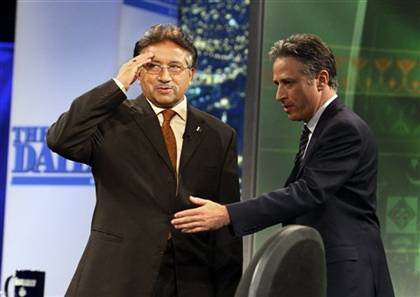
So I just found out that he is going to be on the Daily Show tonight at 11pm with Jon Stewart. I'll definitely watch and see what happens.

Here is the article from MSNBC
NEW YORK - Jon Stewart welcomed Pakistan's president to "The Daily Show" on Tuesday with tea and a Twinkie.

President Gen. Pervez Musharraf's tete-a-tete with Stewart on the Comedy Central program was even more unlikely than the much-anticipated meeting between Musharraf, Afghan President Hamid Karzai and President Bush, planned for Wednesday.

As a gesture mirroring Pakistani hospitality, Stewart welcomed Musharraf with a cup of jasmine green tea, and offered the more American delicacy of a Twinkie. Musharraf chuckled and thanked the host, though Stewart promptly changed the subject.

"Where's Osama bin Laden?" he asked suddenly.
"I don't know," replied Musharraf. "You know where he is? You lead on, we'll follow you."

Musharraf's appearance on "The Daily Show," which was taped late Tuesday and was to air Tuesday evening, was the first time a sitting head of state appeared on the program, a show spokesman said. The comedy show, though, has frequently drawn major political figures, including former President Clinton last week.

The Pakistan president, who is on tour of the U.S., appeared on the program to promote his new memoir, "In the Line of Fire." The book has drawn headlines for, among other things, the Pakistan president's claim that after the Sept. 11 attacks he had no choice but to support the U.S. led war on terror groups or face an American "onslaught."

On balancing the wishes of the U.S. and Pakistan, which is largely anti-American, Musharraf told Stewart: "I've had to learn the art of tightrope-walking many times, and I think I've become quite an expert of that."


Stewart, himself, has also proven deft at balancing both humor and seriousness on "The Daily Show." At one point, he asked Musharraf if he had omitted any mention of the war in Iraq in his memoir because it has "gone so well."

Musharraf again laughed, but said: "It has led certainly to more extremism and terrorism around the world."

To conclude the interview, Stewart put Musharraf on the "Seat of Heat," a new feature for the program in which red lights flash around the studio and the guest is asked a final question.

"George W. Bush and Osama bin Laden — be truthful — who would win a popular vote in Pakistan?" asked Stewart.

"I think they'll both lose miserably," replied Musharraf, an answer met with raucous laughter by the "Daily Show" audience.

Thursday, September 21

'United States threatened to bomb Pakistan "back to the stone age"'

Regardless of what the precise quote was, how is any of this a surprise? Just sad I guess....

Atleast the aftermath of this alliance has resulted in reformation in Pakistan. Which is superb

The United States threatened to bomb Pakistan "back to the stone age" unless it joined the fight against al-Qaeda, President Pervez Musharraf says.
General Musharraf said the warning was delivered by former Deputy Secretary of State Richard Armitage to Pakistan's intelligence director.

"I think it was a very rude remark," Mr Musharraf told CBS television.

Pakistan agreed to side with the US, but Gen Musharraf said it did so based on his country's national interest.

"One has to think and take actions in the interest of the nation, and that's what I did," he said.